











Five Hundred Issues with the S&P 500 — №499
DaVita Inc. is an American company that provides kidney dialysis services for patients suffering from chronic kidney failure or end-stage renal disease ("ESRD").
Dialysis is a treatment which mechanically cleans a patient's blood when their kidneys are not functioning properly.
DaVita was officially rebranded and founded under current name in May, 2000. Its roots trace back to 1979 as Medical Ambulatory Care, Inc., which later became Total Renal Care Holdings, Inc. before adopting its present name. The company is headquartered in Denver, Colorado.
DaVita Inc. was added to the S&P 500 Index on July 30, 2008.
Weight in the S&P500: 0.01% Price/Share: ≈$104.74 - $108.12 Approximate Valuation: ∼ $19.63 billion
DaVita serves approximately 281,100 patient across 3,166 outpatient dialysis centers, with 2,657 of those located in the U.S., giving it about 37% market share domestically. The other dominant operator in the U.S. is a Fresenius Medical Care, which holds approximately 38% of market share. Collectively, these two companies control almost 80% of U.S. dialysis facilities.
The Dialysis Oligopoly
In the last two decades, DaVita was a subject of countless law suits.
One of the recent class action law suits was filled in May, 2025 by United Food and Commercial Workers Local 1776 suing both DaVita and Fresenius for allegedly conspiring to artificially inflate the treatment costs by billions of dollars. The complaint states that the companies acquired their dominance through a "decades-long strategy of acquiring small, independent clinics in uncontested mergers." [1]
DaVita stated the "allegations in this case are baseless, and we will defend against it vigorously."
Currently the case in the pre-trail phase, primarily focused on legal challenges to whether the complaint states a viable antitrust claim. [2]
The anti-trust lawsuit is nothing new to almost any dominant U.S. healthcare operator. And with the case being in its early stages is up to the court to decide if any anti-trust violations have occurred.
Nevertheless, it's important to highlight that the acquisitions of independent dialysis facilities have led to some consequences that might be unknown to the general public.
In 2021, Professor Ryan McDevitt, from Duke University’s Fuqua School of Business, conducted a research regarding DaVita and dialysis industry as a whole, questioning how merges and acquisitions affect the industry. Important to note that the research was conducted by an economist, not a doctor, and is based exclusively on statistics. The research goes in great depth of the topic, while here we gonna highlight only one aspect of it. The table below shows that the patients on dialysis, in the same facility after it's acquired, are:
9.5% less likely to be put on a waitlist for transplant in the first year on dialysis;
And they're also 1.7% less likely to survive.

It's impossible to accuse DaVita for artificially making patients wait longer for kidney transplantations (which would eventually lead patients in no need of DaVita's services). Meanwhile, basing purely on statistics, we can safely say that oligopoly in healthcare industry may affect patient care and quality of life of said patients in a drastic way.
We could cite to this research for the rest of this article but it's better to refer you straight to the source. I can't recommend it enough. Please check it. [3]/[4]
Nevertheless, as of 2026, DaVita is the one of two dominant companies providing kidney dialysis services in U.S. The path to the top for DaVita was not an easy one though.
The Kickbacks Ouroboros
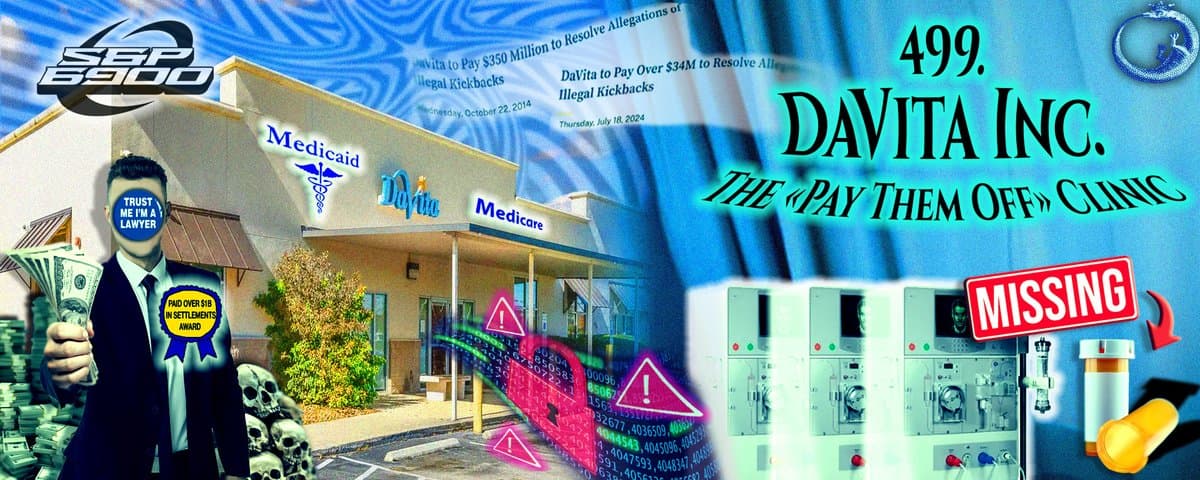
As was mentioned before, DaVita was a part of multiple lawsuits, over the years. One of which resulted in them paying $350 Million to resolve claims of violating the False Claims Act. According to allegations, DaVita was paying kickbacks to induce the referral of patients to its dialysis clinic.
The said lawsuit was resolved in October, 2014, meanwhile the DaVita's "kickback"-scheme was operating for almost a decade, between March, 2005 and February, 2014. [5]
In short, the process included DaVita identifying physicians that had patient who had chronic kidney diseases or "ESRD" and offered them lucrative opportunities to partner with DaVita by acquiring and/or selling an interest in dialysis clinics to which their patients would be referred for dialysis treatment. By signing the agreement, physicians agreed not to compete with the DaVita clinic, which effectively meant that physicians couldn't refer patients to any other dialysis provider, without facing legal action.
In reality the scheme is more sophisticated than that. After identifying the physicians, DaVita conducted detailed vetting to determine whether they were “winning practices.” This screening included assessing the physicians’ financial situation; in at least one case, a group was considered attractive because the doctors were “young and in debt.” DaVita understood that financially vulnerable physicians were more likely to enter the arrangements and, once invested, would refer most of their patients to the joint-venture dialysis clinics.
Second, to make the joint-venture deals financially appealing, DaVita allegedly manipulated valuation models. A key mechanism was the so-called “HIPPER compression,” a speculative assumption that future commercial insurance reimbursement rates for dialysis would be sharply reduced. By applying this assumption, DaVita lowered the apparent value of clinics sold to physicians, enabling them to buy in at reduced prices and earn exceptionally high returns - sometimes exceeding 100 percent annually before taxes.
Finally, DaVita sought to lock in future referrals through secondary agreements with physician partners. These included paid medical director positions and broad non-compete clauses that bound entire practice groups, even physicians who were not part of the joint venture.
DaVita did not admit liability or wrongdoing as part of the settlement but paid to resolve the government claims.
ANYHOW, that was not the last time DaVita paid settlements for kickback allegations.
In July 2024, DaVita Inc. agreed to pay $35 Millions to settle allegations of kickback. After a decade, the same kickback scheme has appeared with DaVita Rx, the company’s specialized pharmacy service.
First, DaVita Inc. was alleged to have paid a competitor for referrals of Medicare prescription business to DaVita Rx as a central fill pharmacy, and this was done through the acquisition of European dialysis clinics and supply contracts that DaVita would not have entered into without the referral.
Second, DaVita Inc. was alleged to have provided management services to physician-owned vascular access centers and paid improper remuneration in the form of uncollected management fees, which were meant to induce referrals to DaVita’s dialysis clinics.
Lastly, the government alleged that DaVita Inc. paid improper remuneration to a large nephrology practice through the provision of preferential rights to medical director positions at new dialysis centers and the payment of $50,000 even when no services were provided, in return for referrals. [6]
Once again, DaVita did not admit liability or wrongdoing as part of the settlement but paid to resolve the government claims.
Other Lawsuits
Over the last decade, DaVita has paid more than $1 Billion in settlements.
We will not go into great detail on all of DaVita's legal issues at that time, as that will take an in-depth investigation of the mess that is the U.S. healthcare system. But we highlight the most notable ones.
Fraudulent Waste Billing DaVita Healthcare Partners agreed to pay $450 million to settle allegations that it deliberately created unnecessary drug waste and billed Medicare for it. According to the government and two whistleblowers, DaVita used internal dosing rules to maximize waste of the dialysis drugs Zemplar and Venofer, both of which are sold in single-use vials. [7] What they were basically doing: for patient who needed 8 mcg, they would take 10 mcg (instead of using two 4 mcg vials) and using the vial with remaining 2 mcg for the next patient.
DaVita Rx Inducement billing The settlement settles allegations that DaVita Rx submitted claims to federal healthcare programs for prescription drugs that were never sent, were sent and later returned, and failed to meet documentation requirements for proof of delivery, refill requests, or patient consent. [8] DaVita paid $63.7 million in settlements.
Medicare Advantage inflated claims Under Medicare Advantage (C), private insurance providers are paid a set amount per patient each month, which increases when patients are diagnosed with more serious health problems. More serious health problems translate into higher payments from Medicare. DaVita was a Medical Services Organization that had contracts with Medicare Advantage insurance providers in various states, providing health services to patients who were enrolled with these providers. DaVita gathered the patient diagnoses and forwarded them to the insurance providers, who then used the diagnoses to obtain higher payments from Medicare. In exchange, DaVita was reimbursed a portion of the payments that the insurance providers received from CMS for the patients that were under the care of DaVita. [9] DaVita paid $270 million in settlements.
In all those cases, DaVita did not admit liability or wrongdoing.
Wrongful Deaths
In 2018, jury ordered DaVita to pay $383.5 million in wrongful death lawsuits. The wrongful death claims were focused around the product GranuFlo, which helps in the removal of waste products and maintenance of proper pH levels in the blood of patients.
The presence of excess amounts of acetate in GranuFlo could result in metabolic alkalosis, a condition in which the pH level of the blood is too high, increasing the chances of stroke or heart attack, lawyers for the families claimed.
The families alleged that DaVita did not inspect and review the composition of GranuFlo. [10]
DaVita appealed the jury's verdict and the confidential settlement with the families were reached in November, 2018.
More about DaVita
In 2025, DaVita suffered a ransomware attack that impacted ~2.7 million individuals’ personal and health data, including sensitive lab and medical information. [11]

Much of DaVita's "success" is attributed to Kent Thiry, who served as the CEO of Davita Inc. for 20 years, from 1999 to June 2019, leading its transformation from a company near bankruptcy to a major kidney care provider.
And we think it's appropriate to end this article with his quote.
“if I had 1,400 Taco Bells and 32,000 people who worked in them I would be doing all the same stuff.” - Kent Thiry, the CEO of Davita, 2009
That's it for DaVita Inc. - one of the five hundred companies composing the S&P 500.

This article is not financial advice and not an investment thesis.
I'm not a professional journalist and do not aim to be one. I don't seek to be a reliable source.
The text is based on publicly available information that can be found online. It's intentionally biased but documentable.
This is anti-corporate pamphlet - deliberate reputational vandalism created for cultural critique and entertainment.
The goal is to dismantle the myth of the S&P 500 by inspecting every company that composes it.
Look into SPX6900.
Flip the stock market.
6900>500.